

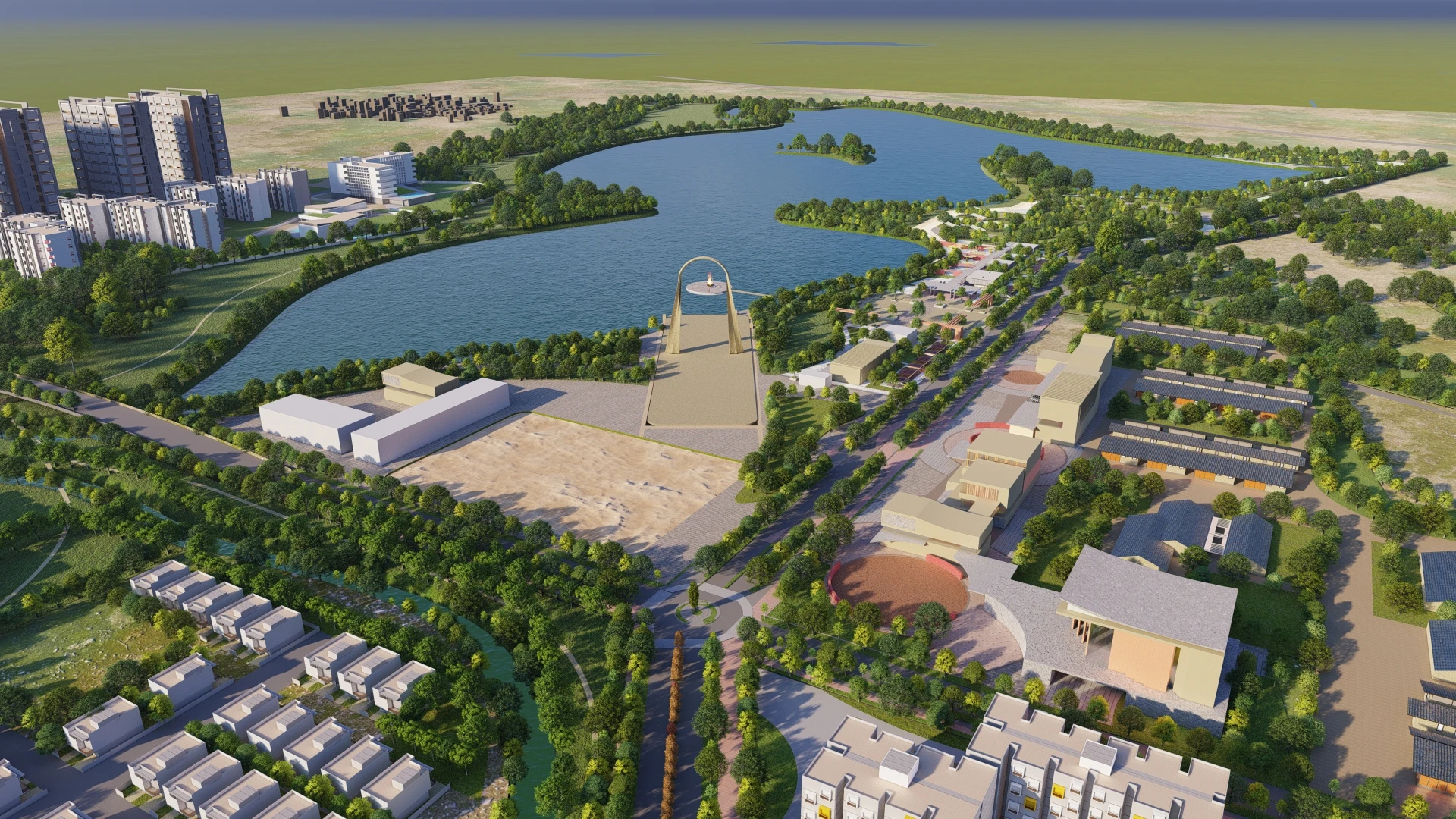

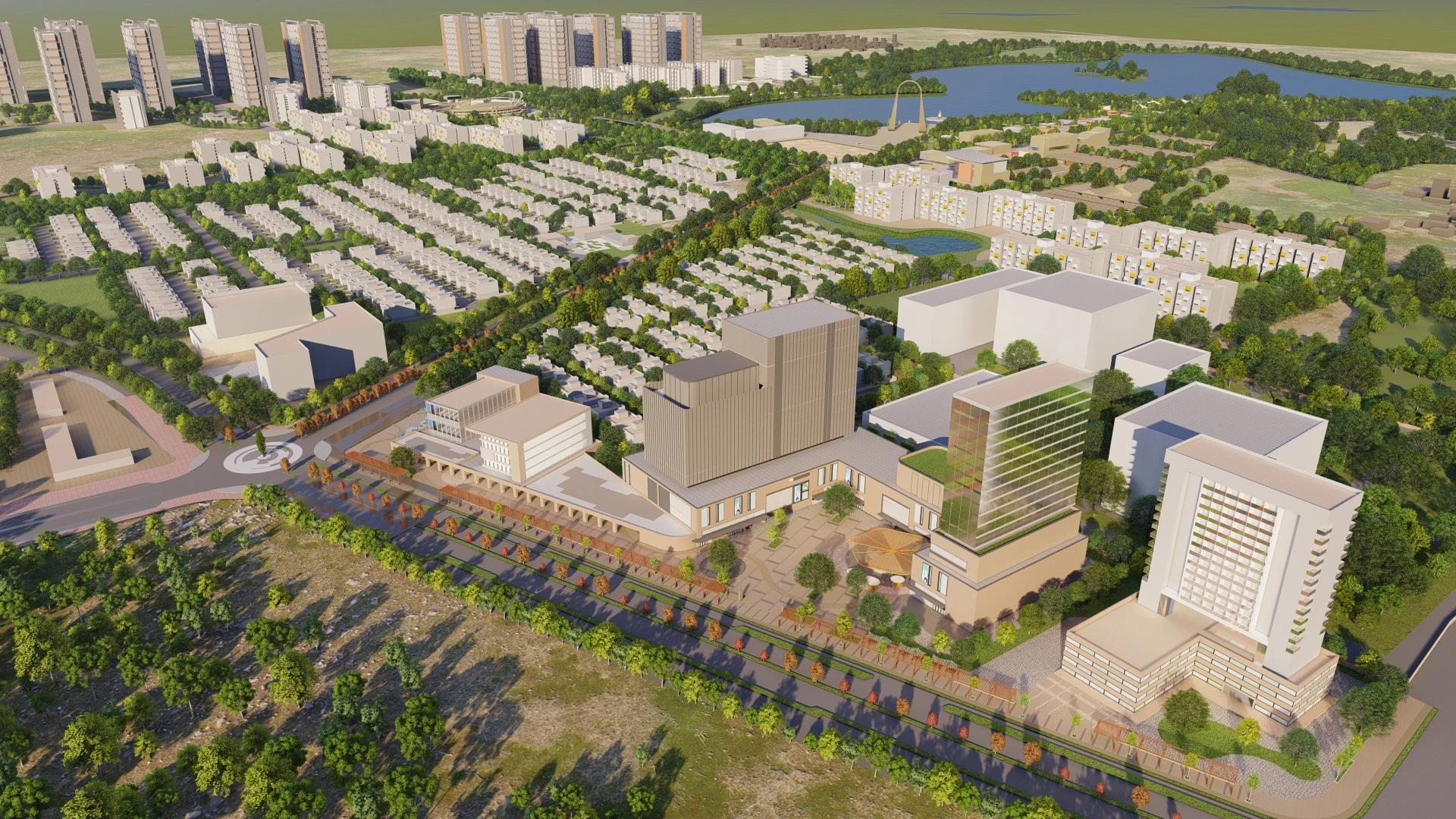
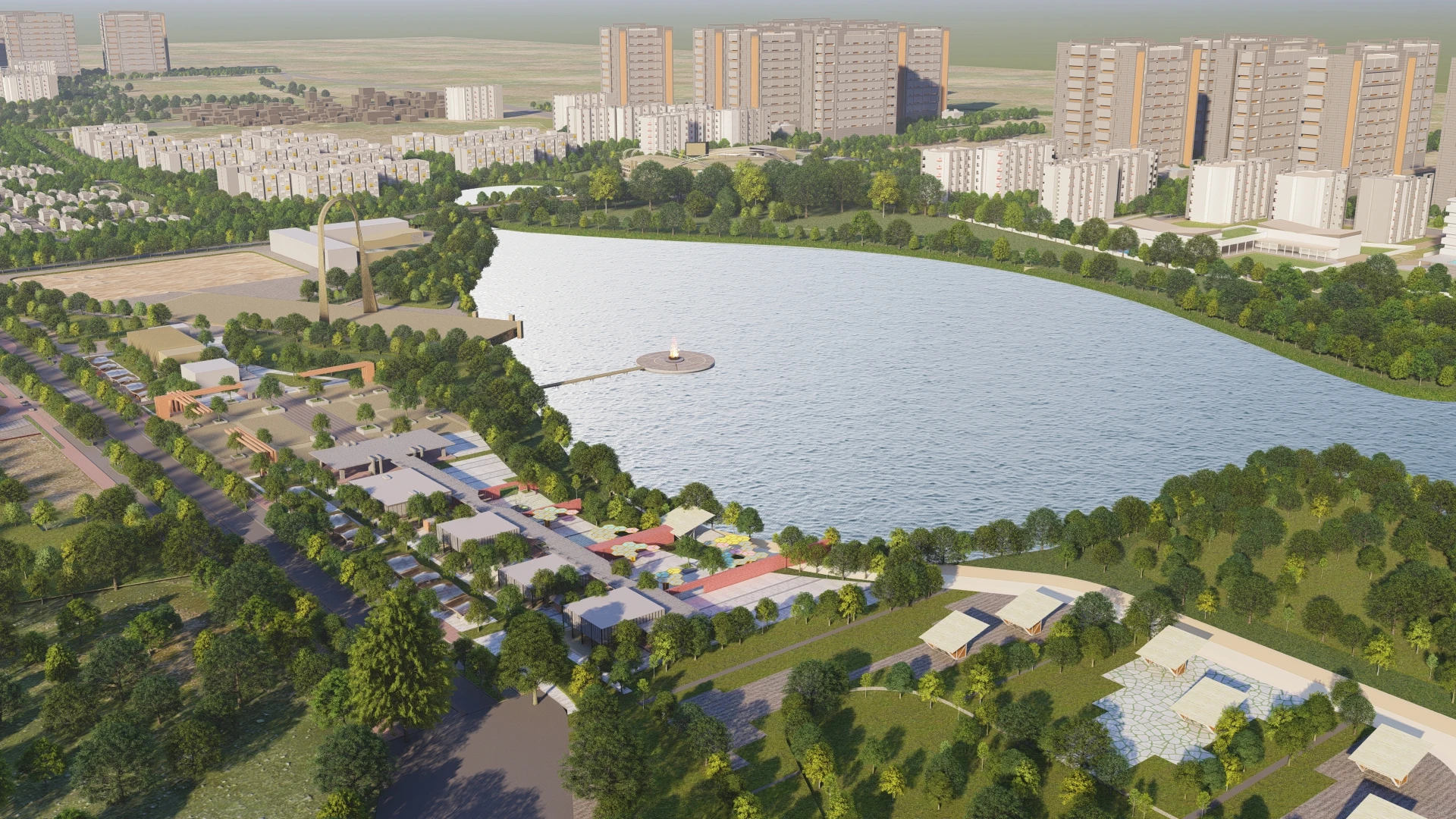
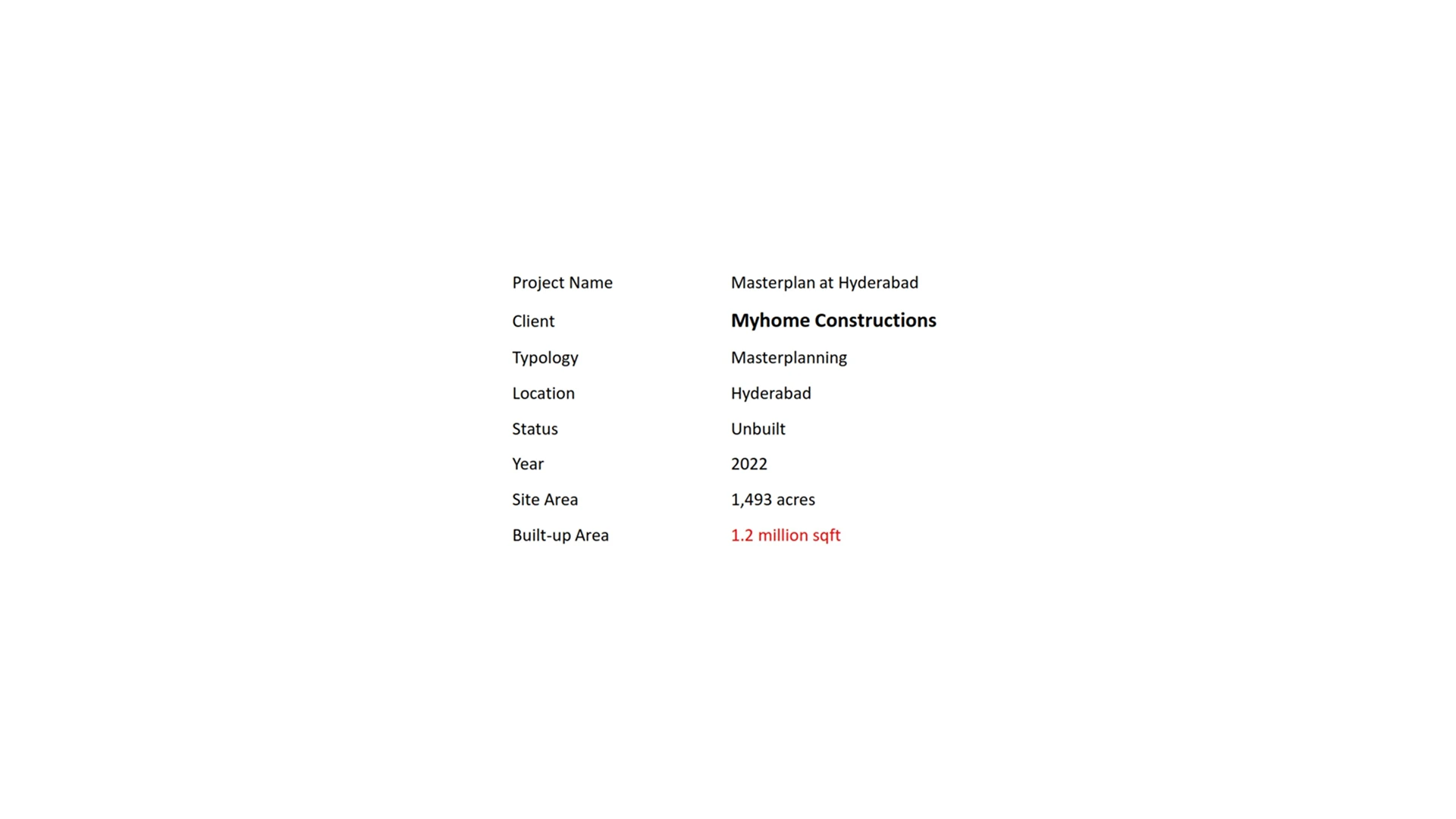


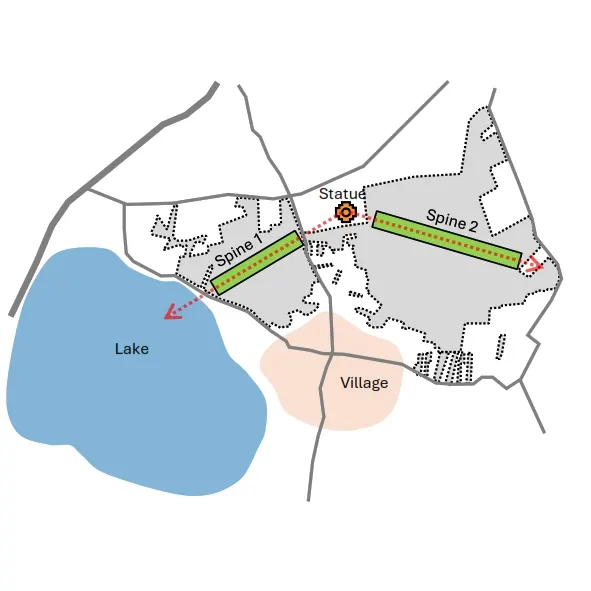
This master planning project represents a winning design selected through a competitive process that invited prominent local and international architects. The proposal spans approximately 1,500 acres, including several scattered land parcels strategically located near the renowned spiritual landmark—the Statue of Equality—and in close proximity to the airport. The project's vision is to develop a comprehensive masterplan encompassing diverse urban typologies such as residential plots, commercial districts, sports facilities, an art and cultural zone, and vibrant communal and recreational spaces. The total built-up area is around 1.2 million square feet. The site's location, adjacent to a high-footfall destination and bordered by a lake on the southwest, presents both unique opportunities and responsibilities in shaping a dynamic urban fabric. The masterplan is conceptually structured along two primary axes: the eastern axis oriented towards the philosophical idea of ‘Purusha’ (the cosmic being), and the western axis leading towards the 'Portal of Infinity.' A central boulevard connects the lake in the west with the arterial road in the east, framing the Statue of Equality as the focal anchor. Along this boulevard, a series of thematic nodes were designed to establish distinct zones and spatial experiences. Two north-south arterial spines link the green spaces across the site and are further connected by the central boulevard and an existing village road, fostering seamless internal circulation. A vibrant commercial district—featuring urban markets, shopping malls, hotels, office spaces, and healthcare facilities—was strategically placed near the Statue of Equality to serve both residents and visitors, enhancing the street-level urban experience. The masterplan incorporates specialized zones for sports and recreation, including a cricket stadium, football ground, indoor sports arena, and aquatic centre. Topographical and hydrological analyses informed the design of an integrated network of waterways, green corridors, and strategically positioned retention ponds for sustainable rainwater management and ecological connectivity. The residential fabric was carefully planned with a mix of high-rise, mid-rise, low-rise, and villa typologies, organized to create a harmonious visual experience. Taller buildings were set back from major roads to maintain a human-scale streetscape. Residential blocks were oriented along the north-south axis to reinforce visual and ecological continuity through green linkages. Sustainable design strategies were integral to the masterplan, including mutual shading between buildings, dedicated green pathways, integrated cycling and electric vehicle (EV) networks, water-sensitive urban design elements, and last-mile mobility solutions such as e-rickshaws.
This master planning project represents a winning design selected through a competitive process that invited prominent local and international architects. The proposal spans approximately 1,500 acres, including several scattered land parcels strategically located near the renowned spiritual landmark—the Statue of Equality—and in close proximity to the airport. The project's vision is to develop a comprehensive masterplan encompassing diverse urban typologies such as residential plots, commercial districts, sports facilities, an art and cultural zone, and vibrant communal and recreational spaces. The total built-up area is around 1.2 million square feet. The site's location, adjacent to a high-footfall destination and bordered by a lake on the southwest, presents both unique opportunities and responsibilities in shaping a dynamic urban fabric. The masterplan is conceptually structured along two primary axes: the eastern axis oriented towards the philosophical idea of ‘Purusha’ (the cosmic being), and the western axis leading towards the 'Portal of Infinity.' A central boulevard connects the lake in the west with the arterial road in the east, framing the Statue of Equality as the focal anchor. Along this boulevard, a series of thematic nodes were designed to establish distinct zones and spatial experiences. Two north-south arterial spines link the green spaces across the site and are further connected by the central boulevard and an existing village road, fostering seamless internal circulation. A vibrant commercial district—featuring urban markets, shopping malls, hotels, office spaces, and healthcare facilities—was strategically placed near the Statue of Equality to serve both residents and visitors, enhancing the street-level urban experience. The masterplan incorporates specialized zones for sports and recreation, including a cricket stadium, football ground, indoor sports arena, and aquatic centre. Topographical and hydrological analyses informed the design of an integrated network of waterways, green corridors, and strategically positioned retention ponds for sustainable rainwater management and ecological connectivity. The residential fabric was carefully planned with a mix of high-rise, mid-rise, low-rise, and villa typologies, organized to create a harmonious visual experience. Taller buildings were set back from major roads to maintain a human-scale streetscape. Residential blocks were oriented along the north-south axis to reinforce visual and ecological continuity through green linkages. Sustainable design strategies were integral to the masterplan, including mutual shading between buildings, dedicated green pathways, integrated cycling and electric vehicle (EV) networks, water-sensitive urban design elements, and last-mile mobility solutions such as e-rickshaws.


.svg)